Best Garmin watches for run tracking and health metrics in 2026
A Garmin watch for running gives you all the insight you need to track your progress and improve your training. Here are some of our favourites...


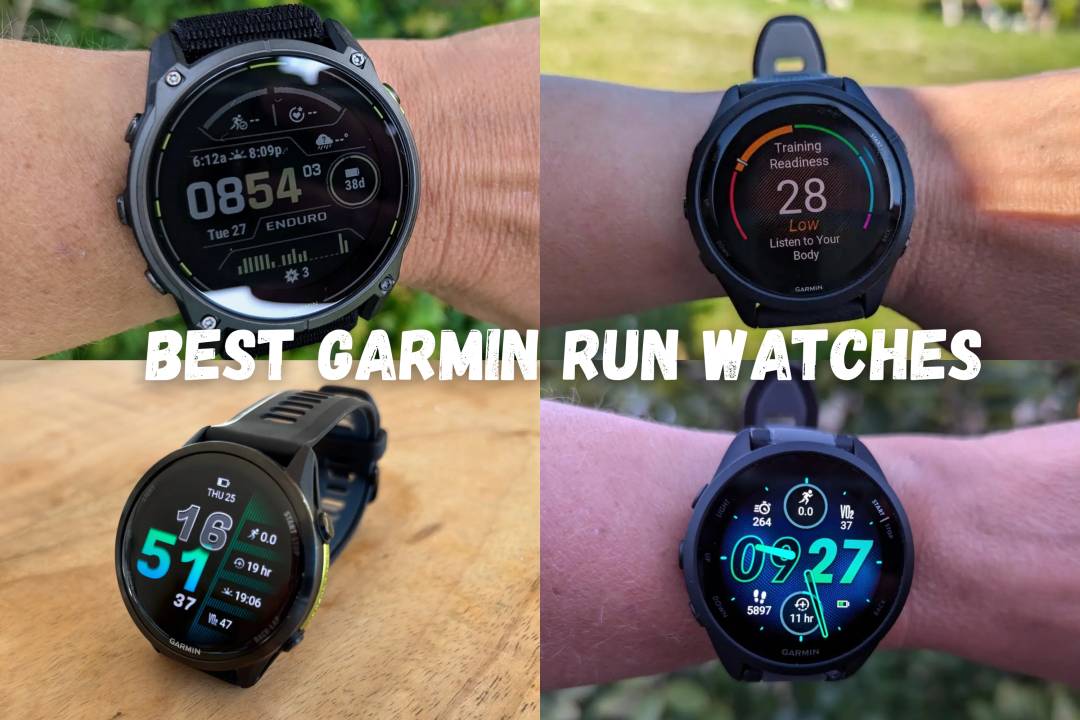
A customer favourite in the wearable tech market, Garmin is a brand we often turn to for fitness tracking. Aside from its sat-navs, dog collars and devices for aviation and nautical activities, it has a huge catalogue of sports watches.
Watch designs cover everything from swimming watches to golf watches, and there’s even a collection of fashion and ‘hybrid’ options for everyday use.
Though, the bread and butter of the brand’s sport watches focus on running, triathlon and other outdoor activities.
If you’re ready to buy your first Garmin watch for running, or fancy upgrading your current device, take a look at our favourites below.
Some focus on running, while others offer a range of functionality and activity tracking across a variety of sports.
Why you can trust 220 Triathlon
Our team of experts rigorously tests each product and provides honest, unbiased reviews to help you make informed decisions. For more details, see how we rate and test products.
Best Garmin watches for running at a glance
For our money the Garmin Fenix 8 (buy) is simply one of the best training tools around. It’s packed with features and has impressive battery life too.
With a whopping 2in screen and classic sports watch styling, the Garmin Instinct 3 (buy) really will stand out from the crowd.
Boosted by solar charging to a claimed 320 hours, the run time of the Garmin Enduro 3 (buy) is unrivalled.
The new flagship Garmin Forerunner 970 (buy) has had a bumper update with more advanced sensors, adaptive training advice, and handy features.
Thanks to its build quality and battery life, the Garmin Fenix 7 Solar (buy) can take you off the beaten track.
Being a simple, but effective running watch makes the Garmin Forerunner 165 (buy) relatively affordable.
Only the 165 here weighs less than the svelte Garmin Forerunner 945 (buy), which offers significant performance benefits in a lightweight 50g package.
An AMOLED upgrade and full-colour mapping make the Garmin Forerunner 965 (buy) a strong choice when you need precise mapping.
With impressive battery and storage for 2,000 songs, you really can keep on running with the Garmin Forerunner 955 Solar (buy).
Packing the longevity of the 955 Solar into a more wallet-friendly package, the Garmin Instinct 2 Solar (buy) is a top pick.
Best Garmin watches for running in 2026
Best Garmin overall
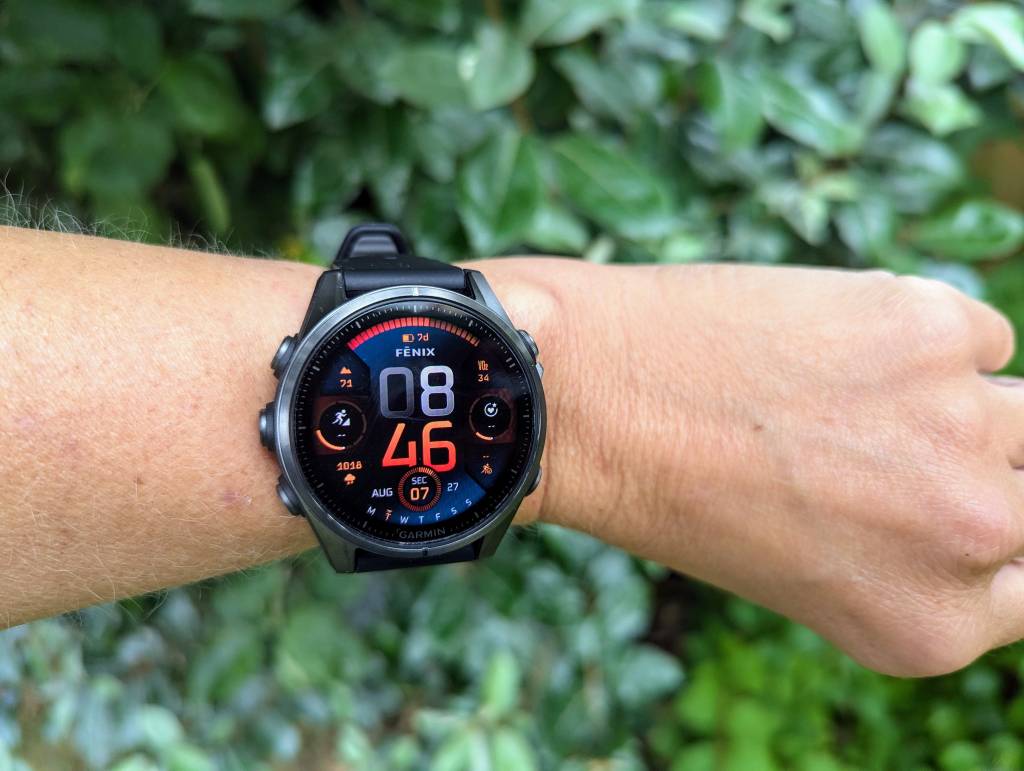
1. Garmin Fenix 8
220 Triathlon Verdict
One of the best training tools around. Barring the price, it’s hard to fault.
Pros
- Excellent screen
- Handy voice commands
- Full of data and features
Cons
- Pricey
| Specifications | Garmin Fenix 8 |
|---|---|
| Price | $999.99 / £949.99 |
| Weight | 2.1oz / 60g (Titanium) |
| Battery life | Up to 10 days in smartwatch mode with 'Gesture'; 28 hours in GPS mode |
| Display | 1.7in / 43mm, 1.9in / 47mm and 2in / 51mm options, AMOLED |
The Garmin Fenix 8 brought a clear AMOLED screen and voice-activated functions to the outstanding Fenix series. You can record all manner of sports and data with high accuracy and for a long time owing to its impressive battery life.
Forerunner users should bear in mind that 43mm is the smallest size this more rugged watch comes in. But extra capabilities do accompany the added weight and bulk.
Review by Helen Webster
Best lightweight Garmin

2. Garmin Forerunner 945
220 Triathlon Verdict
A little dated now, but still a pretty complete running watch.
Pros
- Simple and reliable
- Clever tech and lifestyle features
Cons
- Shortish battery life
| Specifications | Garmin Forerunner 945 |
|---|---|
| Price | $599.99 / £499.99 |
| Weight | 1.8oz / 50g |
| Battery life | Up to 14 days in smartwatch mode; up to 36 hours in GPS mode |
| Display | 1.2in / 30.4mm, 240 x 240 pixels |
Having become the brand’s flagship ‘plastic’ watch for multisport use, the Forerunner 945 is a practical Garmin watch for running. It comes with loads of useful features, but it’s also a fantastic choice if you don’t want the hassle of charging it every day. In GPS mode, the battery can last 36 hours straight.
The watch continuously monitors your progress and adapts its VO2 assessment according to temperature and altitude, while there are a host of different sport profiles for you to track. Also included are music streaming functions, Garmin Pay and incident detection alerts for your emergency contacts.
Check out my full Garmin 945 Forerunner review for more.
Review by Matt Baird
Best Garmin for ultras

3. Garmin Enduro 3
220 Triathlon verdict
A brilliant sports watch that justifies the heavy price.
Pros
- Higher spec than predeccessor at lower cost
- More user friendly
- Huge, solar-enhanced battery life
- Loads of features and data
Cons
- Price remains high
- Minimal solar benefit of solar charging in dull conditions
- Screen isn’t AMOLED
| Specifications | Garmin Enduro 3 |
|---|---|
| Price | $899.99 / £769.99 |
| Weight | 2.2oz / 63g |
| Battery life | 320 hours (claimed) |
| Display | 1.4in / 35.5mm, 280 x 280 pixels |
The Garmin Enduro 3 is a rare breed—an upgraded multisport watch that’s actually cheaper than its predecessor. At $900 (£770), it’s still a premium buy, but its solar-assisted battery life (claimed 320 hours in GPS mode) is unmatched, even if you’ll only see that in sunny conditions.
The larger solar ring doesn’t dim the display, which is clearer than the Enduro 2 but not as sharp as AMOLED rivals. It’s packed with performance features: improved heart-rate sensor, enhanced strength training plans, intuitive UI, flashlight, and smart navigation tools like ClimbPro.
The Enduro 3 is ideal for serious endurance athletes, especially runners and cyclists, and offers music, Garmin Pay, and stock tracking. It’s a fantastic watch, just don’t expect miracles in grey weather.
Read my full review for the Garmin Enduro 3 here.
Review by Helen Webster
Best Garmin Forerunner for navigation
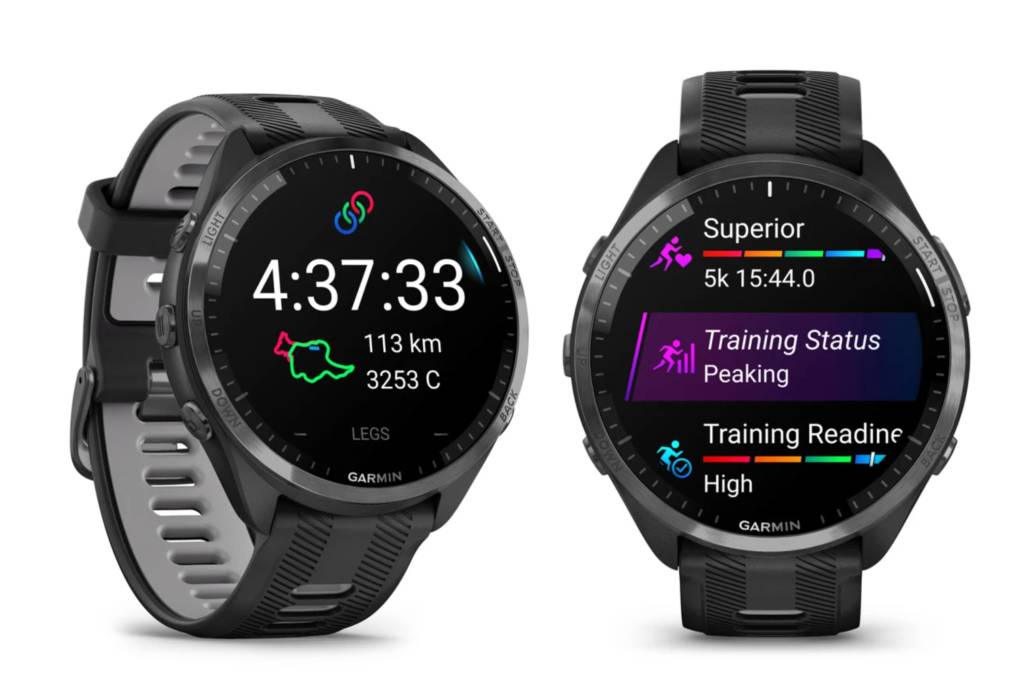
4. Garmin Forerunner 965
220 Triathlon Verdict
Reliable measurement and GPS, and an easier-to-read screen, but run time dips.
Pros
- AMOLED display
- Long training feature list
- Solid GPS and HR accuracy
Cons
- Shorter battery life and higher price than predecessor
| Specifications | Garmin Forerunner 965 |
|---|---|
| Price | $499.99 / £499.99 |
| Weight | 1.9oz / 53g |
| Battery life | 6-7 hours in GPS mode |
| Display | 35.4mm / 1.4in, AMOLED |
The Garmin Forerunner 965 has a better screen than before thanks to an AMOLED upgrade. This makes the extensive data it captures easier to read on your wrist and the definition of the full-colour mapping is higher.
Accuracy of navigation and heart-rate measurement seemed spot-on but that energy-consumptive screen sees battery life tail off slightly.
Read my full Garmin Forerunner 965 review.
Review by James Witts
Best Garmin for offline music
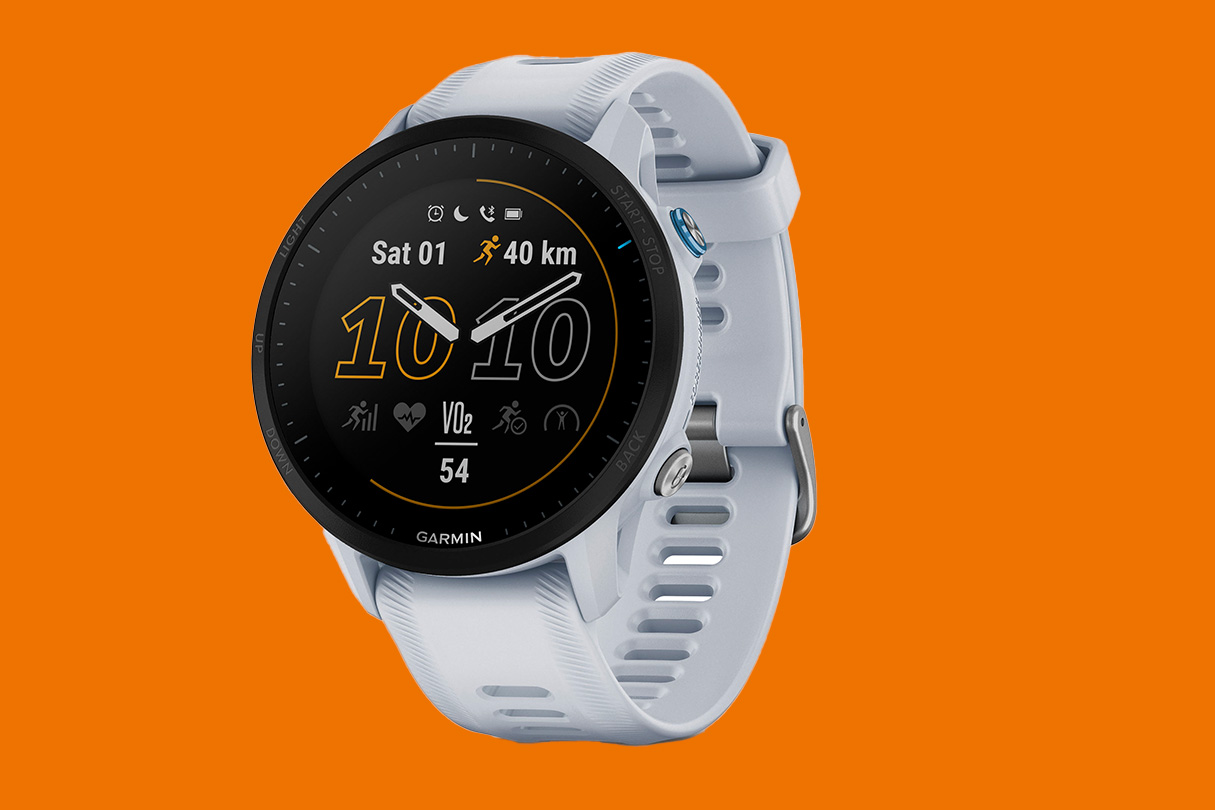
5. Garmin Forerunner 955 Solar
220 Triathlon verdict
Well-thought-out upgrade that lasts longer than ever.
Pros
- Feels lightweight on the wrist
- Excellent gamut of performance features
Cons
- Doesn’t quite feel as premium as the Fenix 7
- Rather high price tag
| Specifications | Garmin Forerunner 955 Solar |
|---|---|
| Price | $599.99 / £519.99 |
| Weight | 1.8oz / 52g |
| Battery life | Up to 20 days smartwatch mode; up to 80 hours with GPS only |
| Display | 1.4in / 35.5mm, 280 x 280 pixels |
The Garmin Forerunner 955 Solar uses solar charging to deliver a massive battery life of up to 20 days in smartwatch mode.
The watch has a well-lit touchscreen that promises to be highly responsive, as well as traditional on-the-side buttons for those who prefer them. The multisport watch includes advanced health monitoring (including VO2 max, heart rate variability, sleep, recovery), smart features and activity tracking.
Additional features that are perfect for runners include running power (when using a compatible device), Training Readiness, suggested workouts, PacePro (which helps you stay at your desired pace) and full-colour built-in mapping.
Up to 2,000 songs can also be downloaded onto the watch, which can be connected to your headphones for phone-free listening.
Read my full Garmin Forerunner 955 Solar review for more.
Review by James Witts
Best budget solar-powered Garmin

6. Garmin Instinct 2 Solar
220 Triathlon verdict
Rugged, lightweight and full of features; another Garmin worth considering.
Pros
- Super rugged
- Impressive battery life
Cons
- Screen isn’t the greatest
- Some top-end features are a miss
| Specifications | Garmin Instinct 2 Solar |
|---|---|
| Price | $399.99 / £299.99 |
| Weight | 1.9oz / 53g |
| Battery life | Up to 13 days smartwatch mode; up to 30 hours in GPS mode; 48h with solar |
| Display | 1.3in / 33mm, AMOLED |
The addition of Solar cranks up battery life to 48hrs in GPS mode, which is plenty for all but the longest of ultra runs.
Solar aside, the big talking point here is the inclusion of Garmin’s fitness features, many of which weren’t present on the original Instinct. These include: VO2 max, Fitness Age, Training Status/Load Effect, Recovery Time and daily suggested workouts.
Heart rate monitoring and GPS accuracy is solid, while point-to-point navigation, a track-back feature and plenty of other data such as altitude, total ascent/descent and coordinates will benefit all. On top of that, you get much of the standard features you’d expect including smartwatch notifications, activity tracking, sleep analysis and step count.
Read my full Garmin Instinct Solar 2 review for more.
Best Garmin for adventures

7. Garmin Fenix 7 Solar
220 Triathlon verdict
Arguably the rating should be even higher, but you can’t ignore this is one hefty outlay.
Pros
- Robust, premium build
- Garmin’s software and features is class leading
Cons
- Price tag is the main drawback
- May be a little heavy or bulky for smaller wrists
| Specifications | Garmin Fenix 7 Solar |
|---|---|
| Price | $800 / £659.99 |
| Weight | 2.2oz / 63g |
| Battery life | Up to 18 days in smartwatch mode; up to 73 hours in GPS mode |
| Display | 1.2in / 30.4mm diameter, 260 x 260 pixels |
Watches in Garmin’s Fenix multisport range are designed to stand up to the toughest workouts while helping you push your own limits.
The Fenix 7 comes with its own fibre-reinforced case and a touch screen, but its best aspect is probably the lofty battery life, which is supplemented by the solar charging technology if you opt for the Solar versions.
You’ll enjoy up to 73 hours of use in the GPS function and you can top up the battery in the sunshine. There’s also the option to switch settings and save power, which can give you up to 18 days of battery life in the standard smartwatch mode.
What’s more, you can see real-time stamina updates as you exercise, and monitor your heart rate, oxygen levels, stress and sleep patterns. That’s all on top of the standard activity tracking you get across a huge range of different sports. Though, all of that does make for a weightier package on your wrist than some of the others in this list.
Find out more in my Garmin Fenix 7 Solar review.
Review by James Witts
Best old-school Garmin

8. Garmin Instinct 3
220 Triathlon Verdict
Top-end tech for a little less with idiosyncratic looks.
Pros
- Brighter screen than before
- Good spec for the price
- Distinct style
Cons
- Mapping could be better
| Specifications | Garmin Instinct 3 |
|---|---|
| Price | $449.99 / £389.99 |
| Weight | 1.9oz / 53g (Titanium) |
| Battery life | Up to 24 days smartwatch mode; 40 hours GPS mode |
| Display | 1.8in / 45mm, 2in / 50mm options, AMOLED |
Although far from cheap, the Garmin Instinct 3 has a good spec and feature list for a watch in the middle of the brand’s range. This third generation gains an AMOLED screen and integrated flashlight seen on pricier models. Mapping and navigation is a little inferior though.
It retains myriad sport modes, including several running settings, and round-the-clock health tracking. Whichever of the four colours you pick, the Instinct’s old-school aesthetics mark it out.
Review by Matt Baird
Best Garmin for run metrics

9. Garmin Forerunner 970
220 Triathlon Verdict
Superb multisport watch at a pretty hefty price but added features are in the most very useful.
Pros
- Accurate sensors and excellent mapping
- Bright and vivid AMOLED display
- Smart tri training and adaptive workouts
Cons
- Pricier than the previous model
- Shorter battery life due to brighter screen
| Specifications | Garmin Forerunner 970 |
|---|---|
| Price | $749.99 / £629.99 |
| Weight | 2oz / 56g |
| Battery life | Up to 14 days in smartwatch mode; up to 26h in GPS mode |
| Display | 1.4in AMOLED display; 454 × 454 pixels |
The new Garmin Forerunner 970 is a standout Forerunner for endurance athletes, offering many of the premium features typically found in the more adventure-focussed Fenix line. The FR970 sports a bright and crisp 1.4″ AMOLED display, reinforced with sapphire crystal glass and surrounded with the classic Garmin titanium bezel you can expect from Garmin.
Advanced metrics such as running tolerance and running economy have been added, which encourage smarter training and recovery. Meanwhile, built-in features like a flashlight and offline voice control positions it as a brilliant lifestyle watch, as well as multisport.
On the performance front, I found the GPS accuracy and ECG-capable heart rate sensor second to none. The topographical mapping and turn-by-turn navigation is also brilliant. That said, the shiny screen comes with trade-offs: the battery life doesn’t stretch as far as some rivals, and unlocking certain data (like economy metrics) demands an extra chest strap.
For serious runners and triathletes who want a rich feature set and premium build, the Forerunner 970 impresses, though it requires commitment to its ecosystem to get your money’s worth.
Read my full Garmin Forerunner 970 review.
Review by James Witts
Best budget Garmin

10. Garmin Forerunner 165
220 Triathlon Verdict
Great watch for the price, no multisport profiles rule it out for tri but ticks the boxes for run.
Pros
- Smaller fit, nice design
- Garmin Connect app is excellent
Cons
- Not suitable for multisport profiling
- Battery life is limited
| Specifications | Garmin Forerunner 165 |
|---|---|
| Price | $249.99 / £249.99 |
| Weight | 1.4oz / 39g |
| Battery life | Up to 11 days in smartwatch mode, up to 17 hours GPS mode |
| Display | 30.4 mm, (1.2in) diameter AMOLED |
One of the increasing large Forerunner family, the Forerunner 165 is a trickle-down option with the main new feature on offer being the AMOLED screen.
The 165 is a more wallet-friendly sports watch, which still offers a clear and tactical 43mm screen, which is somewhat less bulky than others in the range. As expected, the battery life is zapped by the screen, lasting 11 days in watch mode and 17 hours in GNSS mode. Though this should be enough for all but the ultra endurance athletes.
The main drawback with the 165 for triathletes who like seamless tracking when racing, is that the 165 has no multisport option. Granted, there’s plenty of sport profile options available, including running, trail running, cycling, indoor biking, pool swimming, and open water swimming, so this may not bother you.
Overall, the 165 is up there as an affordable smartwatch for tracking tri training. GPS is accurate and health feedback useful. For all the same advantages of the 165 and multisport tracking, check out the Forerunner 265 below ($449.99 / £429.99).
Check out my full review of the Garmin Forerunner 165 for more.
Review by Helen Webster
Frequently asked questions about Garmin running watches
Some Garmin watches use touchscreens (Venu, Forerunner), others stick to buttons (Enduro, Fenix). If you train in wet or cold conditions, tactile buttons may beat a glossy touchscreen for usability.
Don’t be swayed by epic battery life claims unless you truly need it. Ultra-long life matters if you hike for days or are one to forget recharging. But for 45-minute swim or run sessions, most Garmins offer more than enough juice. Overbuying in the battery department just adds to watch size and cost.
Garmin often bundles features like ECG-style tracking, pulse ox, or barometric altimeters. If you’re not planning to analyze elevation gain or oxygen levels, there’s no need to take these into account when making a purchase. Focus instead on accurate GPS and heart rate, those make the foundation of a sports watch.
How we test Garmin watches
To fully and fairly test these Garmin watches, our testers undertook a range of short and long runs, at different intensities, against different backdrops (urban and rural), to gauge accuracy of crucial metrics like GPS and heart rate. The latter they compared against the real-world gold standard of a chest-based heart rate monitor.
Comfort’s important no matter how many features are loaded onto your watch, while battery life’s key, too, as it’s all very well reeling in loads of useful data but it’s redundant if it cuts out halfway through your run workout. Usability and connectivity also play a part the effectiveness, or not, of a running watch.
Meet our testers:
Helen Webster is 220 Triathlon‘s editor and a through and through triathlon expert. Helen knows exactly what goes into a great-performing running watch and has tested many Garmin watches over the years.
James Witts is 220’s former editor-turned-author and tech expert, he tests all things tri tech and nutrition for us. Thanks to his experience in the industry, James brings an expert and trusted voice to all gear reviews he produces.
Rob Slade is 220’s previous content editor. He joined the magazine as a newbie triathlete and quickly moved through the ranks, continuing to test himself with various multisport challenges and distances. Rob is a lover of the finer details and knows exactly how to test the tech and features that go into these run watches.
Matt Baird is also a former 220 teammate and now editor of BBC’s CountryFile. He’s known to throw himself into any and all challenges, the latest being the infamously difficult Ironman Wales.
How to find the best Garmin watch for you

Start with your primary activity
Garmin makes niche-specific watches—some excel at trail running, others at triathlons, and some just track daily walks and steps. Ask yourself: “What’s the one activity I care most about?” Choose a watch that’s purpose-built for that first, then check if it covers your secondary needs.
Decide if you want smartwatch or sport watch first
Don’t just look at features, consider the feel of the watch. Do you want your watch to look sleek under a suit or survive a mud-caked mountain bike ride?
Or perhaps you want a watch the can cover all bases and is versatile enough to wear day-to-day. If you lean more towards a smartwatch (music, texts, payments), stick to the Forerunner or Venu series. Hardcore adventurers may appreciate the Fenix or Enduro models more.
Ignore the latest release, focus on the feature jump
Every new Garmin sounds exciting, but not every upgrade will be a meaningful improvement to your uses. Instead of buying the latest model, compare two or three models back and look for a feature leap you’ll actually use. For instance, map routing, stamina tracking, or solar charging.
Consider Garmin’s model numbering
It’s messy, but there’s a pattern: higher numbers mean more features. Forerunner 55 offers the core metrics; 265 adds AMOLED and music; 965 is elite-level. Same goes for Fenix models (e.g., 7 vs 7X). Learning the hierarchy helps avoid marketing traps.
Recent updates
- 29 October 2025: We added a review of the new Garmin Forerunner 970 to our round-up, introduced our testers, and updated the header image with original tester-shot imagery.
- 11 February 2026: We added shortened versions of our Garmin Fenix 8 Pro, Garmin Forerunner 965, and Instinct 3. We also checked all products were available and added a category to the best table.
- 3 June 2026: We have slimmed the collection of Garmin watches down to 10 – losing the ‘also consider’ section with the Garmin Forerunner 45/45s, Forerunner 245 and Forerunner 55, as well as the Forerunner 265 and Garmin Fenix 8 Pro. Watches are now reordered according to their star rating.


 Helen Webster
Editor, 220 Triathlon
Helen Webster
Editor, 220 Triathlon With contributions from